
5 Luxury Hotels on Lake Como, Italy: Historic Villas, Remarkable Architecture and Lakefront Living
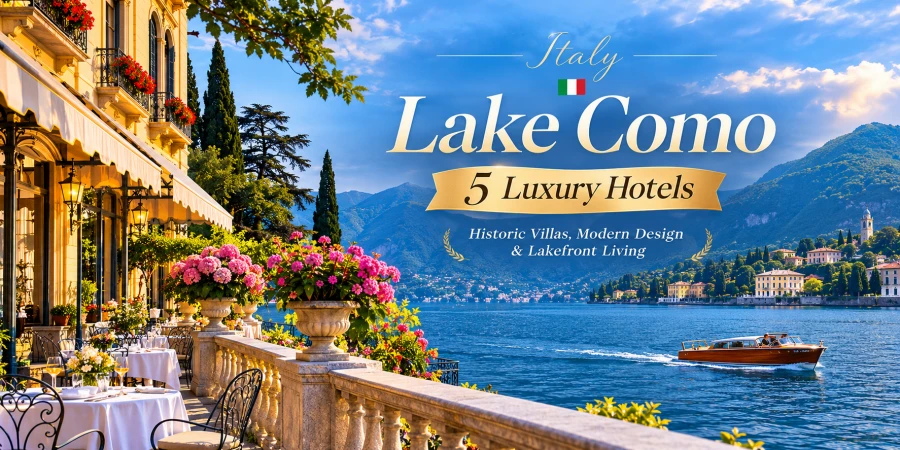
Lake Como is a place where the building you choose can shape the entire trip. A sixteenth-century residence surrounded by formal gardens offers a very different atmosphere from a contemporary hotel built directly into the lakeside landscape. Even the position of a room matters here: a balcony overlooking the water, a garden-facing suite or a private terrace can completely change how you experience the lake.
Five properties stand out for different reasons. Villa d’Este and Grand Hotel Tremezzo preserve the traditions of Italy’s grand hotels, while Mandarin Oriental, Lago di Como combines historic buildings with modern resort facilities. Passalacqua feels more like a private aristocratic residence, and Il Sereno takes a distinctly contemporary approach to architecture.
Villa d’Este, Cernobbio: A Historic Residence with Ten Hectares of Gardens
Official website: Villa d’Este
Villa d’Este is one of the most recognizable historic properties on Lake Como, but its appeal extends beyond its reputation. The estate occupies approximately ten hectares in Cernobbio, on the southwestern shore of the lake, and its architecture preserves the character of a former aristocratic residence.
The property was built in 1568 as the summer residence of Cardinal Tolomeo Gallio. It became a hotel in 1873, and the original residential setting remains central to its identity today.
Two buildings with different histories
The hotel has 151 rooms divided between two principal buildings. The Cardinal’s Building contains 124 rooms and was designed by Pellegrino Pellegrini, also known as Il Tibaldi. The Queen’s Pavilion contains another 27 rooms and suites and dates to 1856.
The difference is visible in the architecture. The Cardinal’s Building reflects the estate’s Renaissance origins, while the Queen’s Pavilion has a distinctive red trompe-l’œil façade and a softer decorative character. Inside, period furniture, paintings, silk fabrics, velvet upholstery and marble bathrooms maintain the traditional grand-hotel atmosphere.
For guests comparing room categories, the view is worth examining carefully. Some rooms overlook the gardens, while others face the lake or include balconies and terraces. The property also offers four private villas within the grounds for guests who want more space and privacy.
Why the grounds matter
The ten-hectare park is one of Villa d’Este’s defining features. Mature trees, magnolias, camellias, citrus groves, sculpted hedges and fountains create a succession of landscaped spaces around the historic buildings. The gardens are not simply a backdrop for photographs; they give the estate its scale and sense of separation from the surrounding town.
Cernobbio is also conveniently positioned for visiting Como’s historic centre, cathedral and waterfront. Villa Erba, another historic lakeside property used for exhibitions and events, is nearby.
I would consider Villa d’Este first for a trip focused on historic architecture, formal gardens and traditional Italian hospitality. It is less about a minimalist design statement and more about experiencing a historic estate that has retained its original character.
Property details: Official rooms and suites
Grand Hotel Tremezzo: Art Nouveau Character and a Floating Pool
Official website: Grand Hotel Tremezzo
Grand Hotel Tremezzo occupies a particularly attractive position in Tremezzina, on the western shore of Lake Como, facing Bellagio across the water. The hotel opened in 1910 and retains the atmosphere of an early twentieth-century grand hotel, with richly decorated interiors and extensive leisure facilities.
Its 77 rooms and suites are divided into categories that make a practical difference to the stay.
Room dimensions and views
The official room specifications list Park View Prestige rooms at approximately 380 square feet and Park View Deluxe rooms at 430 square feet. Lake View Prestige rooms also measure 380 square feet, while Lake View Deluxe rooms measure 430 square feet.
Junior Suites measure approximately 550 square feet. Guests looking for outdoor space can consider the Terrace Garden Suite, which has a private terrace overlooking the lake measuring approximately 300 square feet.
The rooftop categories are particularly distinctive. Depending on the suite, private terraces measure approximately 250 to 450 square feet, with selected categories featuring Jacuzzi mini-pools.
These details are useful when choosing between rooms. A lake view, a private terrace and a larger interior are three separate benefits, so it is worth checking exactly which features are included in the selected category.
The hotel as a destination
The most recognizable feature is the T Beach floating pool, which sits on the lake and creates an unusual swimming experience with open water and mountains in view. Additional pools, a private lakeside beach and landscaped gardens give the property a more resort-oriented atmosphere than a traditional city hotel.
The surrounding area is rich in historic villas. Villa Carlotta, known for its botanical gardens and art collection, is nearby, while Villa del Balbianello stands on the Lavedo peninsula near Lenno. Bellagio can be reached by boat, with travel times depending on the service being used.
For a more exclusive stay, the hotel also offers Villa Sola Cabiati, a separate historic residence with six suites and formal gardens. It can be booked for exclusive use, with access arranged by car or boat.
Grand Hotel Tremezzo is a strong choice for travelers who want historic interiors without giving up the facilities of a full resort. It is particularly appealing for longer stays where swimming, boating and exploring the central lake are equally important.
Property details: Official rooms and suites
Mandarin Oriental, Lago di Como: A Historic Villa Estate Reimagined
Official website: Mandarin Oriental, Lago di Como
At Blevio, on the eastern shore of Lake Como, Mandarin Oriental occupies a historic estate surrounded by a centuries-old botanical park. The setting is quieter than the busy streets of Como, yet the city remains close enough for visits to its restaurants, cathedral and waterfront.
The resort has 75 guestrooms, suites and private villas distributed across nine buildings. This dispersed layout is one of its most important characteristics: instead of placing every guest in a single hotel block, the property creates a more residential experience across the estate.
Accommodation and design
The historic Villa Roccabruna is closely associated with opera singer Giuditta Pasta, who acquired the residence in 1827. The wider property combines historic architecture with contemporary accommodation and resort facilities.
The official room portfolio includes Superior Rooms, Deluxe Rooms, Vista Lago Rooms, Junior Suites, Duplex Suites, Premier Suites and larger specialty suites. Depending on the category, accommodation may include custom-designed furniture, marble bathrooms, walk-in showers, balconies, terraces or separate living areas.
Some suites have kitchenettes and dining areas, making them useful for families or travelers who prefer a more independent arrangement. Views also vary by category: certain rooms overlook the gardens, while others have partial or more direct views of the lake.
A waterfront pool and extensive gardens
The botanical park is central to the resort’s atmosphere. Its mature planting surrounds the historic buildings and creates a sense of privacy, while the lake remains visible throughout the grounds.
One of the hotel’s most distinctive facilities is its 40-metre floating outdoor pool, designed by Herzog & de Meuron. Positioned over the water, it offers an experience quite different from a conventional pool beside a hotel building.
The resort also has extensive spa facilities and dining venues. For guests who prefer to alternate quiet days at the property with excursions, the location works well: Como is nearby, while the central lake villages can be reached by road or boat.
I would choose Mandarin Oriental for a stay that combines the atmosphere of a historic Italian estate with contemporary rooms, wellness facilities and a broad range of services. It offers more of a complete resort experience than a small private villa hotel.
Property details: Official accommodation information
Passalacqua, Moltrasio: The Intimacy of an Aristocratic Villa
Official website: Passalacqua
Passalacqua takes a more intimate approach to luxury accommodation. Located in Moltrasio on the western shore of Lake Como, the property is an eighteenth-century residence restored as a hotel. It opened as a luxury hotel in 2022 and has just 24 rooms and suites.
The smaller inventory changes the character of the experience. Instead of the scale of a large resort, the property is organized around the historic residence, landscaped grounds and a handful of distinct accommodation buildings.
Three buildings, three different atmospheres
The 24 accommodations are distributed across the Villa, the Palazz and Casa al Lago.
The main Villa contains 12 rooms and suites. Its interiors feature high ceilings, stucco decorations, frescoes and Murano glass chandeliers, preserving the decorative richness associated with historic Italian residences.
The Palazz contains eight rooms and occupies a smaller building with exposed oak beams, jewel-toned walls and Venetian silk details. Its atmosphere is more intimate than that of the principal residence.
Casa al Lago has four rooms and junior suites close to the water, with garden access. Its position makes it particularly attractive to guests who want to move easily between their accommodation, the gardens and the lakeside.
The three-building arrangement is more than an architectural detail. When booking, the choice between the Villa, Palazz and Casa al Lago determines the style of accommodation and its relationship with the rest of the estate.
Gardens and the lakeside setting
The grounds extend down toward the water and include terraces, planted areas and a private jetty. The landscape creates a strong connection between the historic residence and the lake, while Moltrasio itself retains the character of a traditional lakeside village.
Como is accessible by road, and the central lake villages can be explored through a combination of boat services and road travel.
Passalacqua is particularly suited to couples and travelers who prefer privacy, decorative historic interiors and a smaller property with a residential feel. It is the hotel I would look at first for an intimate stay rather than a holiday centered on a long list of resort facilities.
Property details: Official rooms and suites
Il Sereno, Torno: Contemporary Architecture on the Water
Official website: Il Sereno Lago di Como
Il Sereno is the clearest architectural contrast to Lake Como’s historic grand hotels. Located in Torno on the eastern shore, the property was designed by Patricia Urquiola and opened in 2016. Its architecture emphasizes natural materials, clean lines and a close relationship with the waterfront.
The hotel was built on the site of a historic lakeside dock, known as a darsena. Its contemporary design draws on the surrounding landscape and local architectural traditions rather than attempting to recreate an aristocratic villa.
Forty lake-facing suites
Il Sereno has 40 suites, all facing Lake Como. The official accommodation information lists sizes ranging from approximately 45 square metres to the 200-square-metre Penthouse, which includes a large private terrace.
The suite collection includes Piccoletta, Lario, Alcova, Garden Lake View, Grand Suite Lago, Corner and Darsena categories, as well as larger penthouse accommodation. Features differ by suite, but private furnished terraces, generous windows and views of the water are central to the hotel’s design.
The materials are equally important. Natural stone, including Ceppo Lombardo on the façade and in selected interiors, gives the building a tactile quality that contrasts with the ornate furnishings found in older properties. The result is a more restrained atmosphere in which the lake itself becomes the dominant visual feature.
Torno and the surrounding lake
Torno offers a quieter setting than Como city, while remaining within relatively easy reach of its historic centre. The cathedral, old town and waterfront make useful excursions, and the central lake villages can be visited by boat or road depending on the itinerary.
The hotel also has a waterfront setting that makes the lake part of the architecture rather than simply a view from a distance. For travelers interested in contemporary design, this is one of the property’s strongest features.
Il Sereno would be my choice for a modern luxury stay, particularly for guests who value architectural detail, natural materials, private terraces and uncluttered interiors more than historical decoration.
Property details: Official suites · Architectural project by Patricia Urquiola
Which Lake Como Hotel Is Worth Choosing?
The right hotel depends on what you want to experience beyond the view.
Villa d’Este is the natural choice for Renaissance heritage and formal gardens. Grand Hotel Tremezzo suits travelers who want pools, a private beach and easy access to the central lake. Mandarin Oriental, Lago di Como offers a combination of historic buildings, contemporary accommodation and extensive wellness facilities.
Passalacqua stands apart for its intimate scale and richly decorated residential interiors. Il Sereno, by contrast, is the strongest option for contemporary architecture and suites designed around the lake-facing outlook.
Location deserves equal attention. Cernobbio and Blevio are convenient for Como city, while Tremezzina is particularly attractive for exploring Bellagio and the central lake. Moltrasio offers a quieter village setting, and Torno combines a contemporary hotel with access to the eastern lakeshore.
Before booking, compare the exact room category, view, outdoor space, seasonal opening dates and transport arrangements. At this level, two rooms in the same hotel can offer noticeably different experiences.
Lake Como’s finest hotels are not simply places to sleep between excursions. Their architecture, gardens and position on the water are part of the destination itself. Choosing the right property can be just as important as deciding which villages and historic villas to visit.