5 Best Places to Stay in Tuscany, Italy: From Historic Castles to Vineyard Retreats
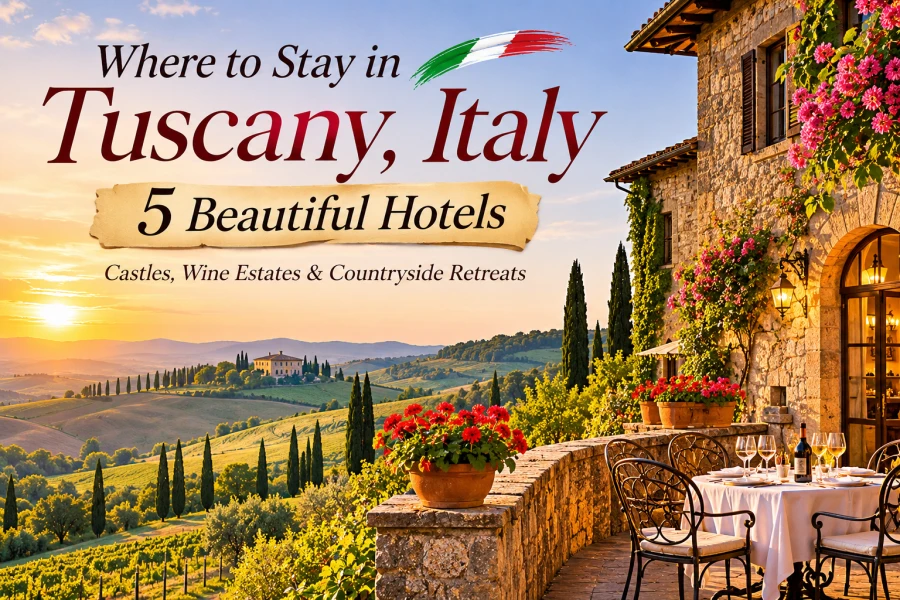
Choosing a hotel in Tuscany can look deceptively simple. The photographs are full of stone farmhouses, cypress trees, swimming pools and terraces overlooking vineyards. Yet a property that looks perfect in a photograph may be poorly placed for the trip you actually want to take.
A hotel outside Siena, for example, is not automatically a convenient base for visiting Florence every day. And a beautiful estate surrounded by vineyards can become frustrating if you expect to walk to dinner or pick up a few essentials in the evening.
I would pay attention to three things before comparing prices: how much time you want to spend at the hotel, whether you will have a car, and which part of Tuscany you want to explore. The five properties below offer very different answers to those questions.
Castello di Casole: A Medieval Estate Where the Countryside Comes First
Official website: https://www.belmond.com/en/hotels/europe/italy/castello-di-casole-tuscany
Castello di Casole is not simply a castle converted into a hotel. Its approximately 3,200-acre estate includes vineyards, olive groves, gardens and a nature reserve, giving the property a scale that is unusual even among luxury countryside hotels.
The historic buildings are surrounded by open Tuscan countryside, with the main accommodation combining traditional materials and contemporary comforts. There is no attempt to turn every room into a theatrical medieval interior. The emphasis is on the setting, the estate’s history and the feeling of staying in a private rural property.
The room choice matters more than you might expect
The hotel has 39 suites and two signature villas. Junior Suites measure approximately 37–66 square metres, while the larger suites range from 61 to 149 square metres. The signature villas measure approximately 250 square metres and accommodate up to seven guests.
For a couple spending most of the day exploring, a junior suite may be sufficient. A larger suite or villa makes more sense if you intend to spend afternoons at the property, travel with children or share the accommodation with friends.
The distinction between a hotel suite and a private villa is especially important here. The villas offer substantially more space and privacy, but the experience is different from booking a conventional room with hotel services immediately outside the door.
The estate also has an infinity pool, the Essere Spa and several dining options. Tosca focuses on refined Tuscan cooking, while Emporio del Castello offers a more traditional Italian dining experience. Country activities include truffle hunting and experiences connected to the estate’s agricultural landscape.
The drawback: you cannot treat this as a city hotel
The official location information gives an approximate driving time of one hour from Florence Airport and 40 minutes from Siena. Siena is therefore a more practical excursion than Florence, particularly if you want to return to the hotel for lunch or spend the afternoon by the pool.
There is another consideration: the property is deliberately secluded. You should not expect to step outside and find a row of cafés, shops and restaurants. Arrange a rental car or private transfers in advance, and plan your evenings around the hotel’s dining options or a properly organized journey into town.
This is not necessarily a disadvantage for a countryside holiday. It becomes one when the itinerary has been planned as though the hotel were in central Florence.
My recommendation: Choose Castello di Casole for a stay in which the estate is part of the destination, with Siena and nearby medieval towns providing occasional excursions. For a short trip dominated by Florence’s museums, I would stay elsewhere.
Official source: Castello di Casole — accommodation, facilities and location
Borgo Santo Pietro: A Country House with Its Own Farm and Food Philosophy
Official website: https://borgosantopietro.com/
Borgo Santo Pietro takes a different approach to the Tuscan countryside. Rather than centring the experience on a castle, the property has developed around a historic country residence, an organic farm, landscaped gardens and a collection of individually designed rooms.
The estate covers approximately 300 acres and includes vineyards, restaurants, a holistic spa and agricultural operations. Its farm-to-table philosophy is an important part of the property’s identity.
There are only 22 rooms and suites. Each is individually styled, with antique furniture, bespoke pieces and decorative details that reflect the history of the building. This smaller inventory gives the hotel a more intimate scale than a large resort.
Why the farm is more than a decorative feature
At some countryside hotels, the farm appears mainly in the marketing photographs. Borgo Santo Pietro places food production and gardening much closer to the centre of the experience.
Its agricultural estate, organic produce and seasonal approach to cooking connect the restaurants to the surrounding land. The property also offers cooking-related experiences and a spa using its own Seed to Skin skincare range.
For a traveller who enjoys food, gardens and rural architecture, that combination is a more meaningful reason to book than a generic promise of luxury.
The 13-acre manicured gardens provide another reason to spend time on the property. The wider estate is extensive, but the cultivated gardens around the hotel have a different character from the surrounding farmland.
A beautiful base, but not a practical stopover
The location is the main limitation. Borgo Santo Pietro lies in the countryside near Chiusdino, with San Galgano, Siena and San Gimignano among the destinations that can be incorporated into a driving itinerary.
The Abbey of San Galgano is particularly worth considering. Its roofless Gothic church stands in an open rural setting, creating a very different experience from visiting the crowded historic centres of larger Tuscan towns.
However, these attractions should be planned around actual driving routes rather than treated as neighbouring sights. A car is the practical choice, and travellers who want to eat at restaurants outside the estate should organize transport before heading out.
The hotel is also better suited to a stay of several nights than a single overnight stop between cities. With only one night, much of the appeal of the gardens, farm and dining experience can be lost to the time spent arriving and departing.
My recommendation: Borgo Santo Pietro is a strong choice for couples, food-focused travellers and anyone who wants to slow down rather than spend every day moving between landmarks.
Official sources: Borgo Santo Pietro — hotel and accommodation · The estate and its history
COMO Castello Del Nero: Staying in Chianti Without Giving Up Contemporary Design
Official website: https://www.comohotels.com/italy/como-castello-del-nero
Chianti is one of the most recognizable names in Tuscan wine, but a vineyard view alone does not tell you whether a hotel is right for your trip. The more useful questions are how the accommodation is designed, what facilities are available and how easily you can reach the places you want to visit.
COMO Castello Del Nero occupies a twelfth-century castle within a historic estate of approximately 740 acres. Its interiors combine original architectural details with contemporary furnishings designed by Paola Navone.
The result is noticeably different from a hotel that attempts to reproduce a medieval atmosphere throughout. Original terracotta floors, high ceilings and historic decorative elements sit alongside restrained modern interiors.
Which accommodation should you book?
The hotel has 50 rooms and suites, with several categories offering different combinations of space and views.
Estate Rooms measure approximately 21–38 square metres and overlook the courtyard or gardens. Tavarnelle Rooms are larger, at approximately 36–50 square metres, and can offer countryside or garden views.
Tavarnelle Suites measure approximately 46–89 square metres and include a separate living area. That extra space is worth considering if you intend to spend time in the room rather than use it solely for sleeping.
For larger groups, the property offers two alternatives to the main hotel. Villa San Luigi is a five-bedroom private villa with a pool, while Podere San Filippo is a restored farmhouse containing 12 self-catering apartments.
These options should not be treated as interchangeable room categories. The main castle provides the conventional hotel experience; the villa and apartments are more appropriate when privacy, a kitchen or accommodation for a group is a priority.
Dining and wine-country excursions
The estate offers wellness facilities, a heated outdoor pool and several dining options. La Torre is the hotel’s Michelin-starred restaurant, making the property particularly interesting for travellers who want to combine wine-country excursions with destination dining.
Its location between Florence and Siena makes it a useful base for exploring Chianti’s villages and wineries. Nevertheless, a rental car or arranged driver is important if you plan to visit several wine estates. Rural roads and separate tasting appointments can consume more time than the distances on a map suggest.
There is also a trade-off with convenience. The hotel is not in the middle of a town, so spontaneous evening walks to independent restaurants are not the main attraction. If you prefer to eat somewhere different every night without arranging transport, an urban hotel will be easier.
My recommendation: Choose COMO Castello Del Nero if you want the character of a historic castle but prefer a more contemporary room, alongside wellness facilities and a strong dining offering.
Official sources: COMO Castello Del Nero — rooms and suites · Official hotel website
Villa San Michele: A Historic Monastery Above Florence
Official website: https://www.belmond.com/en/hotels/europe/italy/villa-san-michele-florence
Villa San Michele is the most practical option on this list for travellers whose plans revolve around Florence. It stands in the hills of Fiesole, in a former fifteenth-century Franciscan monastery, with terraced gardens and panoramic views over the city.
The hotel reopened on 28 April 2026 following an extensive renovation. Its redesigned interiors retain the building’s historic identity while introducing updated furnishings, restored frescoes and materials associated with Tuscan craftsmanship.
What changed in the 2026 renovation?
The hotel now has 39 rooms and suites, including three signature suites named Limonaia, The Grand Tour and Botanica.
Standard rooms measure approximately 29–37 square metres, junior suites start at around 38 square metres, and suites begin at approximately 60 square metres. Signature Suites start at around 109 square metres.
The accommodation is distributed between the historic building and garden areas. That distinction is worth checking when making a reservation: two rooms of similar size may have quite different settings depending on their position within the property.
The renovation also introduced Villa San Michele Spa by Guerlain, alongside renewed gardens and a revised dining offering. The hotel has a panoramic heated outdoor pool and a complimentary shuttle service to Florence city centre.
The shuttle is a useful facility, but it should not be treated as a substitute for checking the timetable. If you have a timed museum entry, a restaurant reservation or a late evening planned in Florence, confirm the return arrangements before setting off.
The advantage of staying outside Florence
The hotel lists an approximate driving time of 30 minutes from Florence Airport and 15 minutes from Santa Maria Novella railway station. Actual travel times vary with traffic and the precise transfer arrangement.
Florence’s major attractions include the Uffizi Gallery, the Duomo, Palazzo Pitti and the Ponte Vecchio. Fiesole itself has archaeological remains and a Roman theatre, making it worth exploring rather than treating the hotel as somewhere to sleep outside the city.
The downside is straightforward: this is a hillside property, not a hotel from which you can casually walk to Florence’s principal museums. You will need to plan transport each day.
For a traveller who wants to spend mornings in the city and return to a quieter setting in the evening, that trade-off may be worthwhile. For a short weekend in which every hour is devoted to sightseeing, accommodation in central Florence may save valuable time.
My recommendation: Villa San Michele is the strongest choice here for a Florence-focused trip that still calls for gardens, historic architecture and a resort-style setting.
Official sources: Villa San Michele — rooms and suites · Official location and transport information
Castello di Velona: A Thermal Spa Castle in Val d’Orcia
Official website: https://www.castellodivelona.it/
Southern Tuscany feels different from the countryside around Florence. The Val d’Orcia is known for its open agricultural landscapes, rolling hills, isolated farmhouses and cypress-lined roads. Castello di Velona sits on a hill overlooking this UNESCO-listed area, combining a historic fortress with a thermal spa resort.
The hotel has 45 suites, three restaurants and an estate that includes vineyards, olive groves and woodland. Its defining feature is a natural thermal spring beneath the property, which supplies the resort’s panoramic thermal pools.
The thermal facilities are the main reason to stay
The OLISPA wellness area covers more than 1,500 square metres and includes thermal pools, a sauna, steam baths and sensory showers.
This changes how the property should be approached. A stay here makes most sense when you intend to use the spa and enjoy the surroundings, rather than spend the entire day driving between towns.
The accommodation includes historic castle-style suites and more contemporary options. Some categories have terraces or private outdoor facilities, so it is worth checking the exact room description rather than assuming every suite includes the same features.
For couples planning a quiet break, the combination of thermal bathing, countryside views and on-site dining can make the hotel a destination in its own right.
Exploring the Brunello wine region
Montalcino is internationally associated with Brunello di Montalcino, one of Tuscany’s best-known wines. The town and its surrounding vineyards are obvious additions to an itinerary, while Pienza offers a historic centre shaped by Renaissance urban planning.
The Abbey of Sant’Antimo, a Romanesque abbey near Montalcino, is another worthwhile stop for anyone interested in architecture and rural history.
A car is strongly advisable. The attractions are spread across the countryside, and public transport is not a convenient way to link every village, winery and viewpoint into a single day.
The remoteness is also the main drawback. You should not book Castello di Velona expecting the convenience of a town-centre hotel. Check the driving distances to your planned restaurants and wineries, and arrange wine-tasting transport in advance.
My recommendation: Choose Castello di Velona if thermal bathing and the landscape of Val d’Orcia are central to your trip. It is less suitable for travellers who want a packed itinerary of city sightseeing and easy evening walks.
Official source: Castello di Velona — rooms, thermal facilities and estate
Which Tuscan Hotel Fits Your Travel Plans?
The best choice depends on where you want to spend your time, not simply on the appearance of the hotel.
| Hotel | Best reason to choose it | Main drawback |
|---|---|---|
| Castello di Casole | Large historic estate and rural privacy | Remote setting; transport planning is essential |
| Borgo Santo Pietro | Farm-to-table dining, gardens and intimate accommodation | Poor fit for a fast-paced, multi-city itinerary |
| COMO Castello Del Nero | Chianti wine country with contemporary interiors | Evening trips and winery visits need transport planning |
| Villa San Michele | Access to Florence with a hillside retreat | Not within walking distance of central Florence |
| Castello di Velona | Thermal spa and Val d’Orcia scenery | Rural location makes a car particularly useful |
For a first visit to Tuscany, I would avoid trying to cover Florence, Chianti and Val d’Orcia from a single hotel. The distances are manageable when spread across several days, but repeated journeys can take time away from the places you came to see.
A more balanced itinerary could begin with two or three nights in Florence, followed by a longer countryside stay in Chianti or Val d’Orcia. That way, city sightseeing does not compete with wine tastings, long lunches and time at the hotel.
Before confirming a reservation, check the room’s exact view and outdoor space, seasonal opening dates, dining availability, transfer arrangements and the cancellation policy. These details can affect the experience far more than a small difference in the headline room rate.
The countryside properties on this list are not interchangeable. One is built around a large estate, another around farming and food, and another around thermal bathing. Choose the experience that matches your plans, and the hotel becomes part of the reason for visiting Tuscany rather than just a place to return to at night.